Showing posts with label Nature. Show all posts

20100424

Arc of the Chasm


“We shall not cease from exploration. And the end of all our exploring will be to arrive where we started and know the place for the first time.“

T. S. Eliot (1888 - 1965)

One grey overcast morning you wake up discovering the existence of a wide chasm that you are sailing across. The distance between the two points of reference is immense striking insecurity in your soul that you are floating high above the rocks without a way to land on either shore comfortably. On one side of the chasm is the life you have created with all of its obligations, responsibilities and familiarities holding you swaddled in the security of a warm blanket? On the other side is the extent of your dreams, aspirations and desires for which you planned to become, seemingly taunting you for your lack of accomplishment. Disillusionment fills thoughts while attempting to understand how the distance between the two became so great. When did the two lives diverge? Why am I unable to project the arc of my life in such a fashion to be closer to the later instead of the former? Is it a common condition of humanity to settle for compliancy and underachievement, or is it a cruel conspiracy of existence that we always craft our dreams into unachievable expectations? Daily distractions are the soma that numbs personal thoughts leading to critical evaluation while we toil away at small insignificant tasks unable to recognize that they have little meaning in the big scheme.

Having spent endless hours staring at the blank white wall of a hospital room in silence provides a perspective of internal reflection few will experience. The process demonstrates the fragility of life that tends to get ignored in the pursuit of racing the clock, but at the same time it reveals the meaningless activities we surround ourselves in becoming a slave to our possessions and constructs of routine. Do not assume in the smallest regard that I am ungrateful for the miracles of recovery that I have been blessed with. I live a sacred life that few can dispute having seen how arbitrarily life can be extinguished or restored between heartbeats. This experience clearly draws into focus how little time exists to accomplish our dreams, while openly ridiculing us at proceeding at a pace that will leave so many aspirations and experiences unfulfilled. I have been given the wisdom to have a perspective of life that is unique, seeing through all the trials and tribulations as if they are rain falling from the sky, destine to be shed without concern and like a raindrop they are transparent unable to conceal their relationship with the streams and rivers that flow endlessly to the sea. Clarify has been the gift I have been given though the intensely personal crisis I have lived twice. Clarify to see what is important and what is not, what is meaningful and what is obtuse, what a distraction is and what brings us closer to achieving a dream.

Clarify does not however allow us to be unencumbered by the morass of our routine and rituals, it just points out the contradictions in our life, begging the obvious question why do I allow myself to be who I’ve become instead of who I wish to be? This is the dilemma of the chasm. We must abandon the comfort of what we know and have sufficient faith to clear the chasm in order to achieve what we desire. I aspire to live an extraordinary life of purpose that makes a difference. With my new clarify of perspective I am angry and increasing bitter at how little progress I continually made toward this goal. In part our new economy is driven by fear and personal interests which diminish the concept of added value of which I have structured my entire business. I am discovering that my old world values of providing added value to relationships is meaningless in this new economy and as a result my ability to make a difference is increasingly futile. The origin of my anger is at the personal sacrifices and investments I have made in people and institutions that are not recognized nor appreciated. At what point is it time to abandon everything I know and go rogue, severing the burden of social responsibility in pursuit of personal exploration and achievement. Be assured that the journey would be much less tedious than trying to drag the entire world along with me. Many days it seems that abandon of social responsibility would never be noticed by the world in general or more incredibility by those closest to me, my staff and collogues for they are so preoccupied in maintaining the routine that they are unable to develop the situational awareness to understand the investment required to jointly succeed in a world that has abandon reason. I find the resentment and angry growing when I am the one sacrificing everything I have saved over a lifetime, investing on the behalf of others in what provides so little equity and so little recognition.

Many have responded to me that the primary difference is that I own the company and I find that line of reasoning appalling. My motivation is not in the title, it is not in the authority, it is not in the power of control, it resides in the opportunity to lead an extraordinary life of purpose. Ownership does not dictate the level of passion one brings to an endeavor; ownership does not instill a commitment to excellence, just because you are an owner does not change anything other than the degree of risk you are will to engage in to live a life of purpose. Ownership is only a vehicle to funnel the commitment that already exists within. The ownership issue is a convenient excuse not to make the investment, to accept mediocrity in execution, to explain the gap between the leadership and the contented. I don’t buy it, in every action we consciously make the decision to succeed or fail by the level of investment we make.

Here I remain, disappointed and angry at myself for not achieving an extraordinary life under the burden of trying to accomplish it within the social context. The time is quickly approaching where I need to decide to accelerate obtainment of my aspirations or to diminish my dreams so I can sit on the edge of whom I’ve become and who surrounds me, fooling myself into believing that being more is unimportant. It is within this context of indecision and doubt that I embark on a small diversion into exploration of the chasm which divides me. Call it a retreat, a sabbatical, a discovery, running away, or whatever you want, but I am on my way to get lose in the wilderness of Big Sur at the edge of the Pacific.

Driven back to the source of my strength I seek the majestic power of the ocean when it meets the earth. I need to be lost in the senses of wind, fog and salt as my muscle burn scaling the isolated bluffs and craggy outcrops of vernal pools and tidal basins. I need to be immersed in the solitude of nature’s timeless wisdom, in the scent of redwoods that have remain unchanged for centuries, in the new spring wildflowers which nod on the sodden hills for I have been lost for so long. I find myself eager to disappear if only for a few days, to where I can feel the cold sand on my skin, where the sharp thorns of sage will punish my skin for its absence, where I can lead an extraordinary life devoid of mediocre execution, devoid of dying embers of social compliancy.

Within this wilderness I shall explore the chasm, scaling its walls of disappointment, fording its rivers of hopelessness, examining in detail the paths and routes which can carry one back to the summit. There is no simple tourist map that can point out the trail, for the chasm can only be revealed and understoodd from within its dark shadows as my breath deepens in anticipation of the exploration. It is within the canyon that I hope to begin the dialogue of healing the divide. My pace increases knowing that the end of my life is gaining ground on me, beginning to handicap my ability to physically and mentally achieve all that I dream. Within an hour I will be in a rental car clearing the expansive fields of garlic beginning to climb the ridges protecting the Pacific from the distractions of the rest of the world. The sun will be setting as the long soft shadows grow from the scattered oaks on the rolling hills. The announcement to fasten our seatbelt blares overhead as I look at the clouds and see a long forgotten smile reflecting in the glass window of the plane. I am content in the fact that I am changing the arc, I am beginning to turn the tide as the journey begins with this first step.


“In human life, art may arise from almost any activity, and once it does so, it is launched on a long road of exploration, invention, freedom to the limits of extravagance, interference to the point of frustration, finally discipline, controlling constant change and growth. “

Susanne Langer (1895 - 1985)

20091003

Spirit of the Mist


"To see a world in a Grain of Sand,
And a Heaven in a Wild Flower,
Hold Infinity in the palm of your hand,
And eternity in an hour."

William Blake (1757-1827)

This is a sacred place of great mystery and spirituality for over ten thousand years. I am but only one of millions over the centuries that have come to witness this spectacular force of nature born of water and rock. A steady stream of cold water runs down my chest forcing me to grasp in short elevated breaths as the mist surrounds me in a white shroud of moisture. Wind drives raindrops against my exposed face unable to see in alabaster blindness, I shift my footing to regain balance. The roar of a million lions would be lost like a falling leaf in a great forest as the tidal wave of sound that assaults the senses. The earth quivers from the power of billions of tons crashing from the sky to ground below. For the briefest of moments we collectively discover how insignificant our life is within the context of this surreal world, humbled by a scale that is difficult to comprehend, yielding to a power that is immeasurable in one’s mind. All my concerns, worries and thoughts erode from the soul in presence of the sublime.

Never before have I been able to find such spirituality with nature while standing shoulder to shoulder in a crowd of hundreds. Assessing the sublime beauty of nature in the past has always been a solitary endeavor requiring silence and reflection as it systematically revealed itself in an intimacy of a new lover. Seldom can I recall the spirituality of nature being so literal and bold, untamed as it screamed to your soul to listen as you have never listened before. As if it was a sign of divine intervention the grey day broke the exact moment before the object of our journey was revealed to our timid eyes. The fog surrounding everything begins to glow with an angelic softness and light. The roar intensifies as it shakes the flesh, while the wind howls with rich organic breath of the essence of all life. Bodies shift and clamor to steady themselves against each other as the footing bounces and bucks like a wild mare. Nothing in life could prepare me for the vision that emerges from the glowing cloud of mist as I try to comprehend the wispy transparent spirits that dance in the fog like jesters swirling on the air in the court of the king. Each gust of water laden air makes the snowy spirits spin in pirouettes as I wipe the dew from my brow. Each of us is covered in a thin blue plastic veil which bellows and balloons around us like a legion of monks huddled before the mouth of a hurricane.

Suddenly the cloud of mist parts revealing a wall of water falling from the sky hundreds of feet above, as a slight sliver of blue sky trace the top of the cascading torrents of water with white cottony clouds dances with soft misty fog blending into a glowing frame in which to view this majestic fury. The scene is completely devoid of color with the exception of the pale stripe of azure sky and the foam green trace of water being refracted in the sunlight. The view is as inspiring as furious, heavenly as destructive, seductive as demanding. My mind reels as I turn my headed only to discover that the wall of water encompasses my entire view in all directions, as the narrow gap we entered from disappears behind the ubiquitous cloud of mist. It is as close to a vision of the gates of heaven I have ever imagined, glowing angelic white, powerfully defensive preventing all but the pure from entering. As the mist washes over me, I feel my sadness, my isolation, my pain subside and be cleansed from my thoughts. Calmness fills me as I deeply inhale the spirit laden mist from this sacred place, allowing me to once again feel joy in the presence of such incredible reverence. It has been a long time since I felt connected to the world, having drifted in a meaningless wasteland of false hope for which there was little comfort. The cold mist had slaps my soul to awaken from a pathetic destructive trance which had been suffocating my mind.

Returning to shore with the balance of the worshipers bathed in enthusiastic glee, I am at once drained but renewed by the short experience up the river. Images of sublime beauty, heavenly power and swirling clouds of mist dancing before my eyes, fills my mind. Discovering this idyllic place, we find ourselves filled with a yearning to linger here, where time has no start or end, but is constant and beauty overwhelms. I have been touched by the spirit of a greater power and it has rendered me tranquil and renewed to set forth with vigor. In the days since my experience at the falls, I have reflected on the sheer power and beauty frequently which in some unique way I am changed. My soul has seen an earthly rendition of the gates of heaven guarded by the spirit of the mist finding comfort in her majestic beauty and to this end I can see her majestic beauty is all I see.


Horseshoe Falls, Niagare, Canada Photo by Mr. Blue

"There is something infinitely healing in the repeated refrains of nature - the assurance that dawn comes after night, and spring after the winter."

Rachel Carson

20080105

The Green Wave: Sink or Swim


“The goal of life is living in agreement with nature.”

Zeno (335 BC-264 BC)

Sustainability is on the minds of every industry as the green movement has reached a critical mass. In the short time frame of fifteen years, green architecture and sustainable technologies have evolved from a radical fringe of ardent supporters to a generally accepted public mandate that is revolutionizing the entire world economy. Below the surface is a monumental shift in corporate thinking which is refining this brave new green world. Every industry will be challenged to make the shift to a new paradigm in order to prosper or even survive. The landscape and nursery industry has always been in the center of the green movement, but is not generally perceived as a leader which consistently brings innovation to the table. There can be no denying the magnitude of the sustainability movement as it becomes increasing codified in our daily life. The time is fast approaching for the landscape and nursery industry to assess its future and decide to either sink or swim in the mounting green wave. The commitment to become leaders in the sustainability movement will require dedication and innovation from both individual businesses as well as trade organizations.

The first question that arises is “what does it mean to be green?” Unfortunately, there are no publicly established policies or guidelines which are definitive, but rather a series of sometimes vague and confusing principals. Being green is easiest described as a way of thinking, in that every action shall do no wrong or diminish the earth’s resources for future generations. The difficult part is that every industry will be required to define these sustainable principals for their specific industry. Be assured that this process will not be simple and the rules will constantly change, but every industry will struggle in defining its role in the new green economy.

The origins of this green tidal wave can be traced back to a single document. In 1992, the City of Hanover, Germany hired architect William McDonough to craft a series of environmental principals to guide architects and planners in the development of exhibits for the 2000 World Expo to be held in Hanover. This short list of environmental goals came to be known as the Hanover Principals. Although over the years these sustainable principals have been expanded, interpreted, defined and debated, they are still the fundamental foundation of the sustainability movement.

As other industries begin to define their role in sustainability, they contribute useful tools which can help the landscape and nursery industry to find its way. Places to look for current thinking and valuable information include the United States Green Building Council (USGBC) www.usgbc.org, which has established the Leadership in Energy and Environmental Design (LEED) green building rating system. The American Society of Landscape Architects (ASLA) www.asla.org has established a strategic partnership with a number of environmental organizations called the Sustainable Site Initiative www.sustainablesites.org to establish a green site rating system for individual sites. There are a number of organizations such as “Cradle to Cradle Certification” www.mbdc.com/certified.html, which helps customers purchase and specify products that are pursuing a broader definition of quality environmentally-intelligent design. Industry specific guides are emerging such as the Certified Forest Products Council (CFPC) www.certifiedwood.org which provides information about sustainable forestry, and includes a directory of sustainably harvested lumber.

Although these organizations provide some insight in how sustainability is interrupted by other associations, none of the documents will address in detail the needs for the landscape and nursery industry. This will come from within the industry as we begin to look critically at the opportunities for changing traditional practices and replacing them with more environmentally friendly business practices. The initial areas for consideration are easy to identify such as business practices that negatively impact air quality, water quality, biodiversity and consumption of natural resources. Let’s look at each of these four simple opportunities in more detail as they might relate to traditional industry practices, knowing that there are dozens of other subjects that should be considered in mainstreaming sustainability into every aspect of the landscape and nursery industry.

Air Quality

With the emissions from operating and refueling of landscape equipment, vehicles have a significant impact on air quality. Small gasoline-powered engines often produce much greater levels of pollution than that of a full sized car per hour of operation. The estimates can be as much as 1000 times more emissions are produced from small gasoline-powered engines. When these engines are mistuned, or run without air filters, measurements show as much as 50% of the fuel exhausted as unburned hydrocarbons. The EPA estimates that as much as 5% of urban air pollution can be linked to their usage. Considering the entire carbon footprint of the landscape and nursery industry, the consequences are significant.

A sustainable approach would minimize air pollution by investing in hybrid or fossil free vehicle fleets as well as a mileage optimization on how those fleets are deployed each day. Small gas-powered engines can be replaced with electric powered equipment. While electric still has environmental impacts primarily in the manufacturing process, the total embodied energy used during the equipment’s life cycle cost is much less. The most environmentally friendly grounds maintenance equipment is human powered which does not rely on a power source. I believe there could be an emerging niche in the market for a premium priced high sustainability ground maintenance service.

Water Quality

The landscape and nursery industry applies a vast amount of chemical based pesticides and fertilizers which, even with the best management practices, are subject to leaching into stream ways and water courses. While monumental progress has been made in training grounds staff in the proper calibration and application of the chemicals, it does illustrate the industry’s reliance on preventative chemical use instead of prescriptive treatment of diseases. An enlightened chemical approach which reduces generic broad based preventative treatments in favor of selective targeted solutions would shift the chemical industry’s investment toward development of new softer solutions. A serious discussion in the landscape industry needs to challenge the reliance on traditional chemical approaches and foster greater acceptance of ecological based approaches.

The greatest impact the landscape and nursery industry has on water quality is in the management of construction activities through the primary responsibility for erosion control. Our experience indicates the landscape industry is only marginally engaged in erosion control. No other trade has a greater opportunity to express leadership in managing water quality during site grading and establishment of vegetation. This industry should be the foremost advocate and expert in site erosion control implementation. Accepting responsibility for the site can expand revenues for forward thinking companies.

With the increased development of suburban areas, more frequent and pronounced flooding has occured. This not only results in erosion, stream pollution, and destruction of aquatic habitat, but tremendous property damage and loss of human lives. Several compelling best management practices exist that the industry can use to help to reduce flooding and reuse a precious natural resource. These stormwater based solutions such as rain harvesting, rain gardens, green roofs and bioswales, while not new have garnered a new wave of public interest. The best thing about these stormwater technologies is that they easily fall into the traditional market of the industry. A concerted effort in promoting integrated stormwater solutions within the industry would represent another leadership position the industry could assume.

Declining Biodiversity

The world's biodiversity is declining at an unprecedented rate, with current extinction rates that are at least 900 times higher than natural rates found in the fossil record. Over 15,000 plant and animal species are now considered at risk of extinction representing an increase of 3,330 species since 2003. The landscape and nursery industry may contribute more to declining biodiversity than it does in preventing it. Consider the impacts of introduction of invasive plants into the landscape, clearing land, establishment of lawns, planting too few species that benefit wildlife, overuse of pesticides and dominant use of limited varieties of plants like Bradford pears and junipers.

When non-native plants "escape" from our landscape and take over natural areas they choke out the wide variety of native plants on which wildlife depends. Our desire for large lawn lots results in significant clearance of natural areas which fragments wildlife habitat. While less than 10% of all insects are harmful to plants, most pesticides are harmful or lethal to all insects. The industry maintains a dominant focus on horticultural planting strategies instead of advocating more complex ecological based plantings. We have become our own worst enemy in perpetuating traditional solutions as the basis of most designs.

A dramatic shift in conventional thinking is necessary to address sustainability in the core of the landscape and nursery industry. The industry needs to develop viable solutions to lawns and corporate landscapes in favor of diverse ecological natural communities which value biodiversity. We need to shift the basis of the green economy from low skilled lawn maintenance labor to more technically knowledgeable resource managers. Along with this paradigm shift comes increased market value and revenue opportunities. The need for biodiversity can be a catalyst in reforming traditional practices into a sustainable future.

Consumption of Natural Resources

The world only has a limited supply of natural resources and consumption rates are increasing. The United States is the world's largest consumer in absolute terms for many resources, eleven of the top twenty. Opportunities for using less are limitless when we look at our consumer economy. Principles for reducing consumption of natural resources can be applied to every aspect of business when you look at areas like packaging, recycling, specifying locally produced goods and use of low environmental impact materials.

Looking specifically at the landscape and nursery industry, specific opportunities emerge when we focus on business operations such as reducing fuel for landscape equipment, conserving water when irrigating plants, mitigating soil lost through erosion and eliminating peat moss or other harvested organic materials to amend soils. The green industry is indirectly responsible for 30% of water consumption in urban areas in the eastern United States for watering lawns, and in the West this figure is 60%. Guidelines for reduction or elimination of irrigation water are commonly available, but the environmental ethics need to be embraced by the entire industry. The green industry can be a powerful advocate in promoting sustainable solutions.

The world is shifting towards an environmental paradigm which fundamentally changes how we conduct every aspect of our lives. This green wave of change is upon us and it is our decision to sink or swim. We can allow the wave to overwhelm the industry or we can choose to participate as leaders riding the wave to a prosperous future of limitless opportunities. The future will be best defined for our industry internally by creative, innovative professions who have a passion for environmental change and civic commitment. By embracing the challenges to redefine our businesses practices at the most basis levels the industry will be guaranteed a meaningful front row seat in the new green economy. There is a lot of work to be done and a short amount of time available, so let’s get started in building a new green foundation for the future.

Do not go where the path may lead, go instead where there is no path and leave a trail.”

Ralph Waldo Emerson

20060411

Profusion on the Plains


Behold, my friends, the spring is come; the earth has gladly received the embraces of the sun, and we shall soon see the results of their love!
Sitting Bull

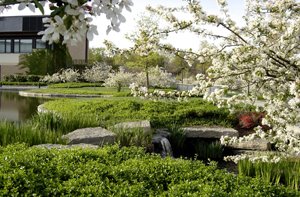
The prairie earth has erupted into exuberance and life. A mild winter followed by a cool March contributed to a glorious spring unsurpassed in decades. In reflection, I cannot ever recall every tree, shrub and flower blooming at the same time. The early blooms of forsythia, magnolia and redbuds share the stage with the late blooms of lilac, dogwoods and crabapples. The daffodils reach for the sky next to tulips. In the average spring this sequence of blooms may extent over four to five weeks as the ground slowly warms and awakes, but this spring all of nature exploded within the same week.

Every view is awash with spectacular color as each species sings in triumph over winter. Every corner is filled with profusion and excess. I have never experienced air so heavily scented with a sensuous mix of perfume. It is a gift to experience another prairie spring as memorable as this one. Today there is no other place I would rather be. I think I’ll turn the phone off, grab a bottle of Riesling and some cheese spending the afternoon at the botanical garden outside of town. I want to lie in the sun and watch this glorious display.